
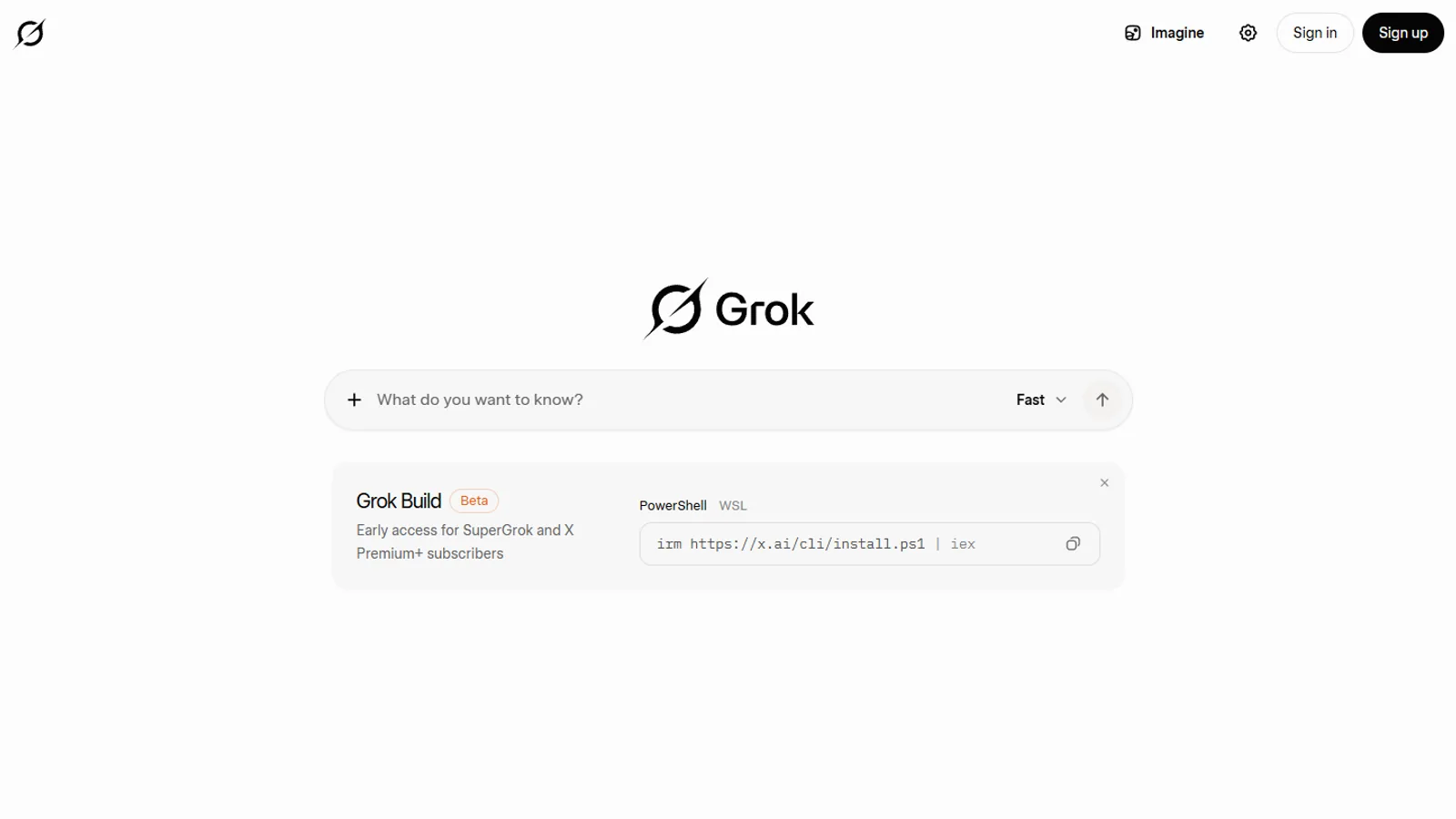
SuperGrok is xAI's paid Grok subscription family for people who want more access than the free Personal Workspace tier. Check the live xAI pricing page for the current plan name and price before you buy, since details change often.
SuperGrok is xAI's paid Grok subscription family for people who want more access than the free tier. xAI's free tier is named Personal Workspace, and its pricing page lists paid paths including SuperGrok, SuperGrok Heavy, Grok Business, and Grok Enterprise. Check the live page for the current list, because plan names change.
That simple sentence is the part to trust. Anything more specific, such as exact pricing, rate limits, or which model is included in a plan, should be checked against xAI before purchase because AI subscriptions change often.
What you get conceptually
SuperGrok sits between casual free usage and the heavier SuperGrok Heavy tier. The practical reason to consider it is not brand loyalty. It is whether your daily Grok usage hits the limits or workflows where a paid plan saves time.
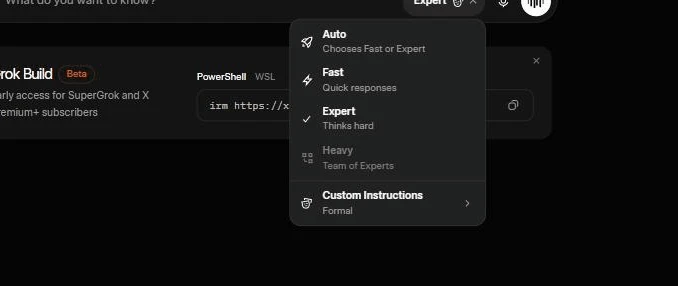
Look at SuperGrok if you regularly:
- Use Grok through its standalone app or web experience.
- Ask long research questions and need more availability than a free tier offers.
- Compare AI answers during work or study.
- Want access to newer Grok experiences when xAI makes them plan-gated.
Skip it for now if you only ask occasional questions or have not tested the free experience enough to know your usage pattern.
Is SuperGrok connected to X Premium?
Grok also appears inside X, and X Help is the best source for Grok-on-X details such as availability, data settings, and how Grok works with X products. Do not assume that a Grok subscription, an X Premium subscription, and a standalone app subscription are interchangeable. Check the purchase screen and official help page before paying.
This is one of the biggest areas where low-quality guides confuse readers. They mix plan names, X Premium tiers, app subscriptions, and API access as if they are one product. They are related, but they are not always the same buying path.
What to check before paying
Use this checklist before subscribing:
- Check the live xAI pricing page for the plan name and price in your country.
- Confirm which app or web surface you plan to use: Grok.com, iOS, Android, X, or API.
- Read any checkout copy about renewals, refunds, and limits.
- Decide whether you need SuperGrok or SuperGrok Heavy.
- Save the official receipt and note the renewal date.
SuperGrok decision tree
Use this decision tree when you are not sure where to start:
| If this describes you | Start here | Why |
|---|---|---|
| You have never used Grok seriously | Personal Workspace or the lowest available test path | You need usage evidence before paying more |
| You use Grok a few times a week and hit limits | SuperGrok | The next plan should remove a real limit |
| You run long sessions and switch tools when capacity blocks you | Compare SuperGrok and SuperGrok Heavy | Heavy should solve a repeatable capacity problem |
| You use Grok mainly inside X | Read X Help and the privacy guide | Account settings and subscription surfaces matter |
| You want to build software with xAI models | Start with xAI Docs | API usage is different from a consumer app plan |
| You are buying for a team | Check Business or Enterprise | Teams need billing, ownership, support, and data review |
The most important question is not "Which plan is best?" It is "Which problem am I trying to solve?" A casual user, creator, developer, and team buyer can all search for SuperGrok and need different next steps.
If your answer is "I just want to see what Grok can do," start low. If your answer is "I already use Grok daily and a limit interrupts work," compare the paid plans. If your answer is "I need a model in production software," leave the consumer plan path and read developer docs.
Where people usually get confused
The Grok ecosystem has several surfaces, and each surface can answer a different question:
| Surface | What it answers |
|---|---|
| xAI pricing | Which paid plan names xAI currently lists. |
| Grok.com | What the standalone Grok experience looks like in a browser. |
| iOS and Android listings | How xAI presents the app experience on mobile stores. |
| X Help | How Grok works inside X accounts and X subscription products. |
| xAI Docs | What developers can use through the API. |
If you read one page and assume it describes every surface, you can easily make the wrong purchase. A mobile app store listing may describe app features. X Help may describe account settings. xAI Docs may describe developer models. None of those pages should be treated as a full substitute for the live checkout page.
Grok, X Premium, SuperGrok, and API: what each one answers
Think of the ecosystem as four overlapping questions.
Grok answers the assistant question: what product experience am I using to ask questions, generate responses, or work with AI?
X Premium answers the X account question: what subscription or feature set applies inside X, and what does X Help say about availability?
SuperGrok answers the consumer access question: what paid Grok path gives me more usage or different plan positioning than the free path?
xAI API answers the developer question: what models, endpoints, pricing, and technical limits apply when software calls xAI systems?
These questions can overlap, but they are not interchangeable. A reader who wants Grok inside X should not rely only on API docs. A developer should not rely only on a consumer plan article. A buyer comparing SuperGrok and Heavy should not treat an X Premium help page as a full pricing source.
That is why this site links the plans guide, privacy guide, official links, and glossary from the core SuperGrok pages. Different reader questions need different source pages.
A practical first-week test
Before upgrading, run a simple seven-day test with the free experience or the lowest suitable plan available to you.
Day one: ask Grok questions you would normally search for. Note whether the answers save time or just sound fluent.
Day two: test a work or study task. Use a real prompt, not a generic demo prompt. For example, ask for a summary of a topic you understand and check whether the answer misses important details.
Day three: compare Grok with another AI tool on the same task. Do not compare vibes. Compare accuracy, speed, follow-up quality, and how often you need to correct the answer.
Day four: test a longer conversation. Some assistants feel strong for one prompt and weaker when the task needs memory, constraints, or step-by-step refinement.
Day five: check privacy and account settings. If you use Grok through X, review X Help and your live settings.
Day six: test mobile usage. If you mainly use AI on your phone, the mobile experience matters more than a desktop review.
Day seven: decide whether the limit you hit is a real limit. If you cannot name the constraint, wait before upgrading.
Seven-day test worksheet
Use a simple note with five columns: day, task, result, limit hit, and next action.
For each day, write one sentence in each column. A useful record might look like this:
| Day | Task | Result | Limit hit | Next action |
|---|---|---|---|---|
| 1 | Explain a current topic | Clear but needed checking | No | Test another topic |
| 2 | Rewrite work notes | Saved 15 minutes | No | Try a longer note |
| 3 | Compare with another AI | Grok stronger on X context | No | Keep comparing |
| 4 | Long research session | Conversation became useful after follow-ups | Maybe | Note where it slowed |
| 5 | Privacy review | Needed X Help | Not relevant | Check settings |
| 6 | Mobile use | Good enough on phone | No | Try during commute |
| 7 | Buying decision | Useful but not blocked | No | Wait before upgrading |
The goal is to catch your real pattern. If every useful task fits within the free or lower paid path, do not rush into a higher plan. If multiple days show the same bottleneck, the upgrade question becomes more concrete.
This worksheet also makes AI comparisons fairer. Run the same tasks in Grok, ChatGPT, Claude, or Gemini if you are deciding between tools.
Good use cases for SuperGrok
SuperGrok can make sense when you have repeatable work where Grok is already useful. Examples include comparing news context, drafting outlines, checking X-related topics, exploring technical questions, rewriting rough notes, and testing different explanations of a complicated subject.
The best use cases share one trait: you can verify whether Grok helped. A broad feeling that an AI is "smarter" is not enough. A useful plan saves time, improves quality, or unlocks a workflow you will actually repeat.
Worked examples
Example one: a student uses Grok twice a week to explain current events and rewrite study notes. That reader should probably keep testing Personal Workspace or a lower paid path until a specific limit appears. Paying for more access makes sense only when the student can say, "I use this enough that the limit interrupts study time."
Example two: a creator uses X all day, checks fast-moving public topics, drafts outlines, and compares Grok answers with other AI tools before posting. That reader has a stronger reason to test SuperGrok because the product sits closer to the work they repeat.
Example three: a developer wants to build an app with xAI models. That reader should not start with a consumer SuperGrok article alone. The better next step is xAI Docs, because API usage, model names, rate limits, and billing are developer questions.
These examples show why one answer cannot fit every reader. SuperGrok is a plan decision, but it is also a workflow decision.
Evidence to save before paying
Before you pay, save enough information to understand the purchase later. You do not need a complicated system. A short note is enough:
- Plan name shown at checkout.
- Purchase surface, such as xAI, Grok, X, Apple, or Google.
- Country, currency, and whether tax appears separately.
- Renewal date and billing period.
- Cancellation path shown by the seller.
- The reason you upgraded.
- Links to the official pages you checked.
This protects you from two common problems. First, it helps if the plan renews and you cannot remember where to cancel. Second, it lets you review the purchase honestly later. If your reason for upgrading was "daily research sessions hit limits" and that no longer happens, the plan should be reviewed.
Weak use cases for SuperGrok
SuperGrok is less compelling if your AI usage is mostly curiosity-driven. It is also less compelling if your biggest concern is handled by a different product surface. For example, if your concern is account privacy on X, a paid Grok plan does not remove the need to check X settings. If your concern is API development, consumer subscription pages may not answer the developer pricing question.
Avoid paying because of one impressive screenshot. AI screenshots rarely show the failed attempts, unclear prompts, or cases where a user already knew the answer.
How this guide stays useful
This page focuses on decisions that remain useful even when plan details change: what SuperGrok is, what it is not, which official pages to check, and how to test whether an upgrade is worthwhile. When xAI changes plan names or product surfaces, the exact buying step should still happen on an official page.
What SuperGrok is not
SuperGrok is not a magic way to make Grok best at every task. AI tools vary by prompt, model version, file type, region, and product surface. If your main work is coding, long documents, image generation, real-time X context, or everyday search, test those exact tasks before deciding.
It is also not a reason to ignore privacy settings. If you use Grok on X, review X Help's Grok page and your account settings so you understand how data controls work.
Our recommendation
Start free, test your real tasks, then move up only when you can name the bottleneck. SuperGrok makes the most sense when your time lost to limits or availability is worth more than the monthly price. SuperGrok Heavy is a separate decision for heavier usage and should be judged against your actual need for capacity.
For the next step, read our SuperGrok plans guide or our privacy settings guide.
Questions readers ask
Is SuperGrok the same as Grok?
No. Grok is the assistant and model experience. SuperGrok is a paid plan name xAI uses for higher access than the free tier.
Should I check xAI before subscribing?
Yes. Prices, usage limits, and feature availability change. Treat xAI pricing and official app listings as the source of truth.
Is SuperGrok.tech official?
No. SuperGrok.tech is an independent editorial site and is not affiliated with xAI, X, Grok, or Elon Musk.
Sources checked
- xAI pricingxAI
- Grok app on Apple App StoreApple App Store
- Grok app on Google PlayGoogle Play
- About Grok on XX Help